FIFA World Cup 2026 Is Coming. Is Your Ad Strategy Ready?

A recent predictions study by Nexxen, built on 1,066 U.S. adult surveys, proprietary discovery analysis, and controlled creative testing, makes one thing clear: this tournament will be watched differently than any before it.
Here's what the data actually says, and what it means if you're buying media around it.
The Audience
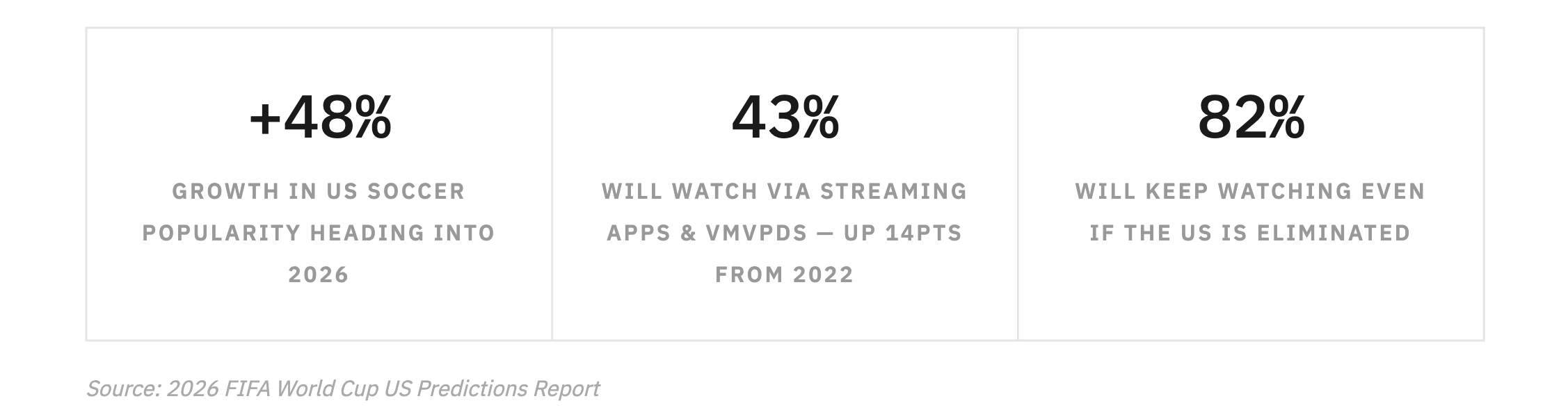
US soccer interest has grown 48% heading into 2026. North America hosting is the top driver, cited by 48% of intending viewers — above friends and family (46%) and platform access (39%). Critically, 82% say they'll keep watching even if the US is eliminated, up 13 points from 2022. This is no longer a fair-weather audience that disappears after the group stage.
Cable is losing this audience fast. Cable and broadcast's projected share of World Cup viewing drops from 45% in 2022 to 20% in 2026. Apps and vMVPDs climb from 29% to 43% over the same period. The big screen stays dominant — 88% plan to watch on TV — but most of that viewing will arrive through streaming apps, not a cable box.
Spanish-speaking viewers are a separate, larger opportunity than most buys account for. This audience averages 3 streaming subscriptions to follow soccer, versus 2 for the general population, and their World Cup enthusiasm outpaces gen pop across every metric. 14% plan to watch in both English and Spanish across platforms. A single-language, single-platform plan misses a large share of the most engaged fans in the market.
Where the Risk Is
90% of intending viewers incorrectly identified at least one platform that isn't airing the matches. FOX and Telemundo/Universo hold the US rights. Nearly every other service fans named — ESPN, Amazon, Paramount+, Netflix — does not. Audiences will show up in the wrong place and either figure it out or drop off. Buyers assuming clean, self-directed navigation to the correct screen are working from a broken premise.
FAST is the wildcard that could reshape the buy overnight. The 2025 Super Bowl sent 15 million viewers to Tubi after FOX added it just one month before the game. The study found 87% of intending World Cup viewers would watch on Tubi if matches were made available there — with Millennials (+33%) and Adult Gen Z (+32%) the fastest to shift. Any campaign locked entirely into premium inventory with no FAST contingency is carrying concentration risk that isn't priced in.
Subscription movement around the tournament is durable, not temporary. 40% of viewers are adding new services specifically for the World Cup, and 67% say the tournament will influence their subscriptions overall. Only 21% plan to cancel post-tournament. The acquisition window between now and the final whistle is the highest-value moment for any streaming publisher — and a retargeting opportunity that extends well past June/July.

What the Creative Data Says
Contextual ad formats significantly outperform standard creative. Controlled creative testing found that ads surfacing real-time value like live scores from concurrent matches, game updates — were rated 36% more enjoyable and held viewer attention 35% longer than standard brand spots. Those same formats drove 24% higher brand curiosity and 13% higher purchase intent. Brands running generic creative against a high-engagement tournament audience are leaving measurable performance on the table.
Daytime matches change the screen and the format requirements. Unlike Qatar in 2022, this tournament airs during US waking hours. Of viewers watching Monday through Friday daytime, 79% will opt for a personal device over a TV. Midday inventory in streaming and digital video carries different creative requirements than the evening big-screen buy — plans that treat the two interchangeably will underperform on both.

The Bottom Line
Audience confusion about where to watch is a distribution moat for prepared publishers. With 90% of fans unable to correctly map the rights, the platforms that make themselves easy to find — through home screen placement, strong discoverability, and pre-tournament positioning — capture disproportionate share. Advertisers aligned with those publishers benefit from the same gravity.
This is a stress test, not just a tentpole. The 2026 World Cup will pressure-test every assumption in a standard sports buy: platform mix, creative format, cross-screen frequency management, and measurement across linear and streaming. The plans built now determine whether that pressure reveals gaps or validates preparation.